In various of my class notes, I’ve posted variations on the story of Shiva’s invention of yoga, following tens of thousands of years of focused meditation on a mountaintop. The classic statute of dancing Shiva shows him holding up a hand in the “stop” position, a jewel embedded in the palm of that hand, symbolizing the action of stopping the endless chatter of the mind through single-pointed concentration, diamond hard and diamond clear.
So is there somewhere in heaven a God in the yogic pantheon perched continually on one leg, the other raised in the dance, four arms akimbo, surrounded by a ring of fire? No. Or at least not one that I’ve encountered. In my way of thinking, Shiva is the embodiment, the essence, the very conception, of single point concentration – the most refined, most concentrated focus imaginable. Perhaps unexpectedly, that tight focus leads to great, infinite – freedom.
In my version of the Hindu pantheon, Shiva is the embodiment of ending, of destruction, of closure, of fire. Not usually the part of life we’re accustomed to celebrating. But through a whole variety of experiences, I’ve come to grasp something of the notion of a god of destruction.
First, there’s the whole “awesome” thing. Quick example to get us started: give a seven-year-old boy a hammer and an alarm clock, and total permission to do whatever he wants, no punishment of any kind, no matter what. Then watch – not just the process, but also, in particular, the boy’s face. There’s something pretty primordial – pretty sublime – to destruction, especially to spectacular destruction. If a car catches fire on the road, what do the other drivers do? They look. Some will even stop to watch.
***
Several years ago, my family traveled from Denver to a small town in Idaho for the 4th of July. As happens across the country, the town had scheduled a fireworks display to begin shortly after dark. After dinner, but hours before dark, we headed to the park/golf course where the event was scheduled. And as is customary in the western US (we never had such luxuries in the east where I grew up), lots and lots of folk arrived early, laid out their picnics and blankets, and proceeded to shoot off their own bottle rockets, firecrackers, shriekers, smoke bombs, Roman candles and the like.
The town had roped off and set aside space for such collateral antics, in the hopes of keeping the excitement a reasonable distance from picnic blankets, but antinomianism tends to rule the day in this part of Idaho, and bottle rockets were zipping from everywhere to everywhere. One – or maybe it was an errant Roman candle – lodged in a lone pine tree on a fairway. Lodgepole pines only form the straight lodgepoles they’re named after when they grow tightly packed together in forests and thickets. This one, all alone on a fairway, was a big bushy thing. Its needles were at the mid-summer’s highest point of dryness. And with the ignition of an errant firework, it lit up like a torch.
We were situated about two hundred yards from the tree, well out of harm’s way, but with a clear view of events, albeit at a distance. Everyone near the tree backed away to a moderate distance, watching. The handily close fire engine sirened up and headed over. As the flames engulfed the tree, those who had moved back once, moved back some more. And something else was remarkable – things got a lot quieter. The background din of hundreds of picnics and chatting and radio music suddenly became the peculiar sound of the oblivious radios and the hushed tones of hundreds of humans turned to watch the fire.
Once the initial flash burn of outer needles subsided, the fire engine got close enough to spout water over the tree, a process that doused the flames, though much more slowly than I’d expected from my experience of dropping a match into a glass of water.
The tree extinguished, a sense of relief moved through the crowd that generally returned to its pre-show level of din.
My two oldest boys went off to the roped off area to light off the pyrotechnics we’d picked up for the day. The adults talked and chatted as the dusk settled toward darkness.
Beyond the roped off area for personal pyrotechnics was another roped off area for the official fireworks. I saw a man dressed in fire gear holding a torch move to the first set. He ignited a fuse, backed away, and a rocket shot into the sky and began the evening’s intended display. He ignited a second fuse, backed away, and, instead of heading up to the sky, the rocket tipped and shot, as if it were a cartoon, straight into the cluster of yet-to-be-fired fireworks. The man in the fire gear backed away. One after another, a chain reaction of fireworks igniting one another began and grew to an unbelievably large burst of flame and spark and colors and sounds and heat. The experience reminded me that fireworks are designed to explode several hundred feet in the sky, where their heat dissipates. Not so for fireworks on the ground, let alone all of them at once.
Our oldest boys, between us and the fireball, but still far from any real danger, came running straight back to us, silhouetted against the growing fireball. Farther back, the man in fire gear began running away, too.
The huge ball of fire grew for a time, as the heat ignited even those fireworks that hadn’t been directly in line of a spark or flame. It was, literally, awesome. Terrible. Enrapturing. Fearsome.
***
When I was first taught to chant OM, the teacher explained that it was really composed of three sounds, not two. Instead of “O” and “M,” as one chants it, the sounds run from “Ah” to “U” to “M.” And, my teacher explained, the silence that precedes and follows the OM is as much a part of the OM as the experience of the vibrations that form the sound components. OM is a manifestation of existence: it begins. It sustains vibration for a time. And it ends. The end is as much a part as the beginning.
***
One last example. Several months ago, during my teacher training, the instructor introduced us to the practice of placing gifts – sacrifices to the gods – onto an altar that is then ignited and burned. Svahah is the phrase for the practice – giving up something to the divine fire. Whether the offering is a measure of flour or a ten-dollar-bill or a no-longer-needed emotion or a practice that no longer serves one or whatever, “svahah” is the phrase for letting it go.
A student comes to a teacher and asks the teacher for wisdom. The teacher lifts a teacup and begins pouring in tea. The cup fills, yet the teacher pours. The tea spills over the sides and to the floor, yet the teacher keeps pouring. The student is alarmed and asks why the teacher would keep pouring tea into an already filled teacup. “Exactly,” says the teacher.
First, svahah.
***
So what is Shiva, what is a single point meditation? A meditation focus can be the breath, it can be the fluctuations of the mind, it can be other things. It is investing all of my awareness in that focus. I’ve never managed (or even tried) to sit on a meditation cushion (or my feet or a block or whatever) for more than a pretty short period. But even so, the effect of that meditation is not limited to the seconds I’m in meditation.
Is that because I, effectively, am in meditation “off the cushion”? Or is it that the meditation simply affects more than the time in which it occurs?
If so, how is that? Is it through memory? Changes to neural pathways – like a highway construction today can change traffic patterns tomorrow? Left over brain chemicals? Are the effects limited to myself or a function of the way that I interact with others, so that even if I’m not benefiting from yesterday’s practice, others I dealt with “under the influence” have changed in response to that, and continue to interact with me today?
Whatever the mechanism or technology involved, yoga changes things off, as well as on, the mat.
So when I begin a practice chanting “OM namah shivaya,” am I not worshipping a Hindu deity? If you want, ok. But it’s an awfully not-too-anthropomorphic deity – it is god embedded in the operation of consciousness, god-imbued fields and particles dancing, god-like patterns of focus and mindfulness, concentration and expansion, attention and awareness. It is the endlessly expanding, concentric effects of concentration.
***
Before I step onto my yoga mat, I bring my hands to my heart in the anjali mudra, 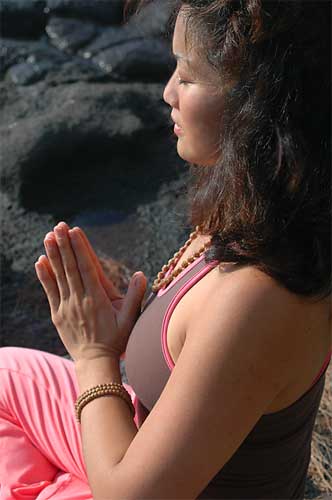
, or “prayer position,” to honor the empty space above my mat, into which I will move, and within which I will flow during my practice.
The space is negative, empty, vacant, void.
Yet it is the field without which my consciousness could not move at all.
Sunday, July 16, 2006
Shiva

Sunday, June 18, 2006
Alertness and Relaxation
Asana must have the dual qualities of alertness and relaxation.
--Yoga Sutras, 2:46
So said Patanjali a few thousand years ago.
Why those two characteristics? Shouldn’t asana have the quality of strength? Of flexibility? Of curiosity? Of contemplation?
I’ve been practicing this week trying to keep in mind the qualities of alertness and relaxation. In that practice, they seem to be connected – by their absence, if nothing else. I tend toward striving in my practice. I suspect that it isn’t coincidental that the noun for striving is strife. I frequently feel a kind of strife in various poses – backbending Crescent Lunge, Dolphin, Horse, a few others. When I move into those poses, I’ve come to expect discomfort, weakness, inflexibility. Strife, I suppose. And, of course, strife manifests not only in my mind, but in my body, as well. My toes clench the floor. Sometimes my shoulders rise toward my ears. The crease between my eyebrows deepens. The breath stops or accelerates.
Teachers pick up on those details. They coach, cajole, joke, touch, trying to draw my attention out of the strife. And always, they call for steady breath, in and out through the nose.
Why?
What is the difference between a mind that is striving and a mind that is relaxed and alert? One can engage only its own object. The other can engage everything.
Wednesday, June 14, 2006
Home-styling
Since I completed training, several friends have expressed interest in learning more about yoga.
Sometimes the discussion starts with a bit of yearning: "I wish I were more flexible. Yoga helps with that, right?" Sometimes with a particular question, "I think I can do all of the sun salutation. Is there more?" or "Down Dog hurts my shoulder. Am I doing something wrong?" Usually, though, it's more generalized: "I'd like to be able to relax and be quiet."
The conversations tend to end awkwardly, as I don't teach at a studio to which I could invite them. I try to respond helpfully, but as I talk, I see the light and interest fade as they realize there's no obvious solution.
So here's what I'm thinking: perhaps one evening a week when I'm in town, I'll hold an "open workshop" at my house. I'll be practicing that evening. I'll clear a space in the living room for mats, and anyone who wants to come is welcome to join in. What I haven't figured out exactly is how such an evening would proceed. But I'm inclined to play it by ear and see. Or at least that's what I'm thinking of, right now.
What would you think of such a thing?
bodies bodies everywhere
The Body Worlds 2 exhibit has been open at the Denver Museum of Nature and Science for several weeks. My wife, my youngest son, and I finally got around to attending on Saturday.
No blinding flashes of insight. Just the same kind of fascination I had with the cadaver work we did during teacher training, I described several months ago here.
Perhaps one key gain: a deeper appreciation for the fact that consciousness can be embodied, and what is missing when it is not. So far as I can tell, consciousness can exist only embodied, whether my own or a chicken's. (Note: I'm not inclined to test my theory beyond the chicken level at this point. ;-))
That recognition makes me appreciate a little more the very ability to perceive and experience and move and feel.
Something to think about in this evening's practice.
Saturday, June 10, 2006
Calm Abiding
In the course of a long practice session, the instructor calls for vrksasana, Tree Pose. It’s one of the really-basic-everyone-does-it-reasonably-well poses. But we don’t do it all that frequently in the vinyasa classes I tend to frequent. Perhaps it’s too static, too calm. Perhaps it’s too “easy.” It consists, basically, of simply standing on one foot, the other foot propped against the standing leg. From there, you can certainly embroider it, if you want, but that’s the gist of the pose.
The instructor calls the pose. I move into it: left foot flat on the floor, ankle strong and centered, knee in full extension, hip as neutral as if standing on both feet, right foot aligned heel-to-toe along my supporting left femur, toes just reaching the top of the left knee capsule. Right, bent knee drawn back, opening the pelvis. Torso and ribs lifted. Arms, yesterday, clasped hands to opposite elbows behind me, putting a little bend in my lower back. Neck long, chin slightly tucked, lengthening the cervical spine just a little bit more. Gaze one-pointed and steady.
I turn my inward attention to my left foot. It is stable, today. Sometimes I tend to balance on the outer edge of the foot in vrkasana, to counter the weight of the bent right leg. Today, though, my hips make the counter-weighting adjustment, my standing foot quiet, stable, strong.
And I find in the quiet, stable, and strong attention of my foot, the power of yoga. Yoga, as I’ve noted before, is union, yoking together. In vrksasana, now, it is the yoking together of my standing foot and all the immensity of the earth beneath it. Not some metaphysical union, though that happens sometimes. Not even a Whitmanesque conceptual union, though that happens at other times. Just the simple union of two, each strong, quiet, and stable, in contact along a plane of connection, each pressing against and supported by the other. Partner yoga, indeed.
Tree pose teaches rootedness.
Saturday, May 27, 2006
Wring-neck pose
Q: So how does a recently-minted vegetarian, long-standing yoga practitioner wind up wringing the necks of chickens?
A: An hour ago, I stood in a dusty chicken coop, breathing and noticing the fight/flight drumming of my heart, hard enough to make my entire chest cavity rattle with each beat.
Two roosters, ten or twelve hens scattered around me. Each of the hens bore unmistakable signs of rooster scars -- bare patches of skin, pecked raw, cut by spurs. One rooster half torn up by the other, tearing, in turn the hens. My nephews and niece unable to gather eggs, as the roosters (both the gorgeous and pristine alpha, as well as the torn-up beta) attack them, too.My brother is a physician -- a healer. A person for whom death is anathema, let alone killing.
In shoulderstand earlier today, drishti focused on my feet, I looked past the roll of fat around my middle, then shifted my gaze to it -- to the scar on my belly where I'd been clawed by the spurs of a rooster who seemed big enough to me, at 9 or 10, to eat me alive.
How do I reduce suffering in such a world?
I'm currently reading Animals in Translation, by Temple Grandin, an amazingly insightful animal behavior scientist. She describes in some detail the results of breeding programs aimed at developing a particular characteristic. Emotionally defective animals result. In particular, she describes rapist roosters, roosters that not only mate with hens, but brutalize them continually. I'd never heard the phrase before last week. This evening, my brother reports on the way the two roosters mount and mate, again and again, with a particular hen, never letting her even stand up.
I go into the coop, heavy gloves in case the roosters are not interested in going gently into that good night. I make a grab for the pristinely feathered alpha. He dodges away. I realize my heart is pounding, and I stand to breathe and be present.
Eventually, I corner him, grab him around the neck, and -- feeling the warmth of life through the gloves -- twist my hands in opposite directions. He spasms. I twist farther, breathing. Warmth. One more twist. A flutter of wings, and he's dead.
The beta is no more interested in gentle departures. I catch him and kill him, this time more quickly, as I've learned from the first pose how to deepen the twist more readily. I act with greater surety, muscle memory aiding.
Then the matter is done. The hens are disturbed. They calm. My heart, trip-hammering at the outset, is calmer, then calm.
I have done what I concluded would reduce suffering, what was as near to the right thing to do as I could evaluate.
But here's the question I'm left with -- if it was all a function of rational thought, why did I kill the alpha first, especially when the beta would have been easier to grab?
Wednesday, May 24, 2006
Why teach?
Recently, my youngest son asked me to practice yoga with him. We do that occasionally -- sometimes as often as once or twice a week. In fact, it was the prospect of practicing with him that shaped my thinking about taking teacher training -- certainly not the only thing, but one of them.
A couple of days earlier, he had asked me to spot him in Adho Mukha Vrksasana -- Handstand. Part of my -- my inner-Iyengar task master -- wanted to tell him that he wasn't ready for it, rather in the style of Jack Nicholson's rage-ridden Nathan Jessep in A Few Good Men, "You want Adho Mukha Vrksasana? can't handle Adho Mukha Vrksasana!" But it occurred to me that that was a lesson that life teaches pretty well on its own. It doesn't need my help. So I complied with my son's request.
As a practical matter, he only kicked his leg up to about waist-high. I caught it and lifted his lower body into Handstand. His shoulders had a limited range of motion -- they didn't extend straight over his head, but rather cantilevered forward about 15 degrees. From a pure body-mechanics perspective, any shoulder tilt away from vertical in Handstand puts all kinds of stress on the shoulder joint, which has to muscle the levered body above it into line. When my son dropped back to the floor, I told him that Downward-facing Dog practice would help a lot with his shoulder strength and extension. So when he proposed practice with me, he asked for lots of Down Dogs.
Shoulder things are the same in Down Dog as they are in Handstand. But Down Dog is a much safer place to practice. It has the added advantage of gravity pulling in the right direction to create the extension, drawing the back and arms into a single line, rather than angling at the shoulder. After several Down Dogs, my son requested Handstand again.
This time, I showed him how to position himslef correctly next to a wall: You place your hands and forearms on the floor, parallel with each other, shoulder width distance apart. Slide your forearms and hands forward until your fingertips touch the wall. Notice where your elbows touch the floor. Then move the heel of each hand back to the elbow spot. With your hands in that place, walk your feet toward your hands, then lift one leg to vertical, kicking off the other into Handstand. One leg bends at the knee so the foot can rest against the wall behind you for support, the other extends vertically. The hand positioning ensures that you can touch the wall bending the leg only at the knee. Closer to the wall than that, and you can end up tilting your whole body toward the wall. While that will strengthen your arms, it won't teach you anything about balance. Farther away from the wall than that and you'll end up in something of a backbend with a lot of weight against the wall. Inverted backbends are tricky enough without adding the peril of toppling into a wall. The ideal wall-supported Handstand has the toes of the bent leg just touching, then releasing, then touching, then releasing from the wall as your brain makes sense of what it means to "stand" upside down, and as your hands discover what your feet figured out years ago.
A brief touch of Handstand was all he wanted. That done, we moved back into a restful practice -- a few cat/cows, a couple of cobras. Instead of camel, in which he tends to crunch his lower back, I had him drape into a backbend over an exercise ball and breathe, expanding his abodomen and intercostals.
We ended in Vajrasana, Thunderbolt Pose (sitting on heels, straight spine, hands in prayer position at the heart) for three or four minutes of meditation. When done, he sighed and vigorously rubbed his nose. He said that a stray hair had caught at the edge of his nostril, tickling with each in-breath. But rather than scratching it during the meditation, he just tried to notice it.
Amazing.
Thursday, April 27, 2006
Discomfort
From Wai Lana:
Three-Stage Perseverance
Some yoga poses are easy for us; we like doing them and practice them
regularly. Sometimes, however, we try a new pose that stretches muscles we don't
often use or requires us to muster up strength. That's when our resistance kicks
in.
Let's say you learned a new pose yesterday that was quite hard for you.
When it comes time to do it today, you're reluctant. You know how stiff you were
in that pose, how little movement you got, and it felt uncomfortable. So you're
inclined to skip that one. But those are just the poses your body needs.
If you persevere, you'll go through different stages as you work with the
pose. The first stage of reluctance usually lasts about a month. But as your
body loosens up, you'll move into the second stage. The pose becomes tolerable
and your body and mind no longer resist so much. This stage may last another six
weeks or so, getting better and better. Finally, you'll get to stage three; the
pose will be quite pleasant and enjoyable. At that point, when the pose becomes
easy for you, it's time to find another pose that you're reluctant to do.
I like Wai Lana's point. What she describes is approximately what I experienced with Crescent Lunge during our teacher training exercise. My hips tend to be pretty tight, and the straight back leg extension in CL was almost impossible for me if I lunged more than an inch or two with my front leg. So I disliked the pose altogether. But we did so many of them in training, that I just learned to suck it up. Over the course of that training, I did begin to notice nothing that felt like real progress, but tiny differences over time. I've noticed in bits and pieces the gradual lengthening of my back leg. And I found that straightening the back leg got easier. Perhaps the leg was getting stronger. Perhaps the muscles wrapping the hip had lengthened. Perhaps my mind reduced its opposition.
Then yesterday, I was in a class at the nearby studio, and the teacher seemed to have a fetish for low lunge and crescent lunge. As we repeated, again and again, the poses, I lengthened into my now standard version of Crescent Lunge. The teacher looked at my pose, knelt in front of my lunged leg, grasped my lunged calf just below the knee joint, and leaned back, drawing my lunged leg forward, until my lunged knee was exactly over my ankle. She then nodded, released my leg and moved on. I looked at the lunged leg. It was in the classic position -- ankle-to-foot: 90 angle. Thigh-to-calf: 90 degree angle. Top of thigh parallel with the floor. Pelvis and shoulders squared to the front. Then I noticed my back leg -- straight from hip to heel, resting on the ball of the foot. I lengthened my arms higher toward the ceiling and experienced Crescent Lunge.
It was by no means an easy pose for me -- so I still have miles to go. But it is interesting to see, in hindsight, the tiny increments in strength, flexibility, and the strange combination of mental devotion and letting go that led to where I am today.
Wednesday, April 26, 2006
Matching Breathing
A challenging meditation I’ve tried this past week: Try matching your breathing to someone else’s. Observe the other’s breath pattern – it’s really only two or three issues: timing in, depth, timing out. Then match it with your own. This can be done with anyone whom you can observe, whether a newborn, a co-worker, a sleeping partner, your dog, or a guy on the train.
Resistances? If the other breathes more deeply than you tend to, it’s painful to stretch your diaphragm and intercostals to reach the other’s normal range of motion. If the other breathes more shallowly than you tend to, it can leave you feeling undernourished. If the other breathes more rapidly than you, it can increase your perceptions of stress. If the other breathes more slowly than you, it can produce a sense of lethargy, or, alternatively, of panic if you feel you’re not getting the amount of air you usually do.
But as a meditation, no matter what the other’s breath pattern, there are lots of mind effects associated with turning over to another something so central to one’s own sense of self, independence, and control. Emotions related to the other well up during this exercise, whether love or anger or otherwise.
I find this as hard as watching my own breath without changing it – something I’m not sure I’ve ever mastered. As soon as I begin paying attention to my breath, how can I know whether I control it more than when I’m not paying attention to it?
In teacher training, one of the first instructions we received is, before making any adjustment to a student’s pose, match your breathing to the student’s. Why? Breath-matching takes the teacher out of the position of dominion. If you’re matching your student’s breath, you’re changing your own actions and sensations to conform to another’s, not the usual approach for asserting control. Breath-matching begins to align energies of the teacher and the student. The more aligned their experience, the more the teacher’s perceptions, knowledge and intuition can be brought to bear on the student’s experience. Breath-matching reduces the likelihood of injury to the student, as the teacher is working with, rather than against, the expansion and contraction of the student’s body. Breath-matching through all these things, and through things less readily perceptible, aligns prana of the two, dissolving some of the distinctions between them, creating yoga.
Breath-matching, in this practice, is an extension of empathy and compassion. We tend to think of those actions as appropriate to suffering, since they aid in reducing suffering, but they are equally appropriate to joy, or to strain, or to peacefulness, or to happiness and ease. Compassion and empathy need not be left in the closet, like an umbrella, for rainy-day use only. Indeed, the best engagement with life is a constant connection and flow, whatever the weather.
Thursday, April 20, 2006
Seeing through here to heaven
I had this morning a glimpse of heaven.
I grew up in the suburbs of Washington, DC. And though I’ve lived in Denver for as long, at this point, as I lived in DC, childhood memories seem to have a way of setting baselines that later experience sometimes does not. So Spring, for me, is defined by things I no longer see during the months of March, April, and May – azaleas, dogwood blossoms, the fall-reminding colors of newly emerging hardwood foliage.
The morning started with an automated wake-up call from the hotel’s computer, telling me that it was 5:30 (3:30 to my time-zone-unadjusted brain). I managed to get myself showered, checked out, and into a cab headed for the airport by 6:30 – dawn. I looked out the window and thought, “It’s Spring.” I’d spent every moment yesterday from the time I arrived to the late hour I made it to my hotel bed in meetings in conference rooms or restaurants. So I savored the dawn-lit moments of the drive from the hotel back to the airport, past banks of azaleas, tulips, redbuds, and the thousand shapes of new leaves, dogwoods blooming, wisteria vines trailing lavender clusters up into the tops of the trees.
But interrupting my Garden of Eden from a cab’s window was an incessantly chatting cab driver.
Looking out the window, I “yes”ed and “no”ed enough to keep up my almost-irrelevant side of the conversation. But as we drove, the flood of Eritrean-accented English began to penetrate my brain. The driver emigrated from Eritrea, via Sudan, twenty years ago. His oldest daughter, 22, is finishing college at George Mason University and about to begin medical school. His second daughter, 19, is a freshman, also at George Mason University. He recounted tales of being pressed into the Eritrean military, ultimately fleeing with his wife and some family members when conditions became unbearable. He told me the “usual” story of third-world life: no justice system to speak of, no economic opportunity, the grinding, the life-and-mind-destroying conditions of poverty. They hid in the jungle during the day, traveling toward the Sudanese border at night. A brother who had already come to the United States sponsored them, via the embassy in the Sudan. He told me of his father’s visits to the U.S., that his father reported this: that of all the people he’s known who have died, none have come back from heaven, so for him, at least, heaven is a belief. But what he sees in the U.S. – that is heaven: the opportunity to work and earn a living; education for children; almost no public corruption and when it does happen, it’s prosecuted; no racial discrimination (relax, this is his report, not mine). That, for him, was and is heaven.
By profession, I’m a lawyer. By training, I’m an antitrust lawyer – a lawyer who works at the intersection of law, competition, business, and society. It’s a lot of economics, a reasonable amount of law, and a lot of inquiry into the hyperactively technical and minute details of how competition works.
This morning’s talk with my Eritrean cab driver reminded me of this:
Heaven is a place of justice and free markets.
Thursday, April 13, 2006
Empathy
Yoga, or "union" entails all kinds of connections between and among people.
Saturday, April 08, 2006
Reading Notes: Stages of Faith by James W. Fowler
Ok -- this is going to be long, so I've broken it into two segments -- this one summarizes a piece of a book I've been reading recently -- Stages of Faith: The Psychology of Human Development and the Quest for Meaning, by James Fowler. The next post will be a quick study of my life based on the analytical structure Fowler develops. How is this yoga? See part 2.
Fowler, through some four hundred interviews he and others conducted and analyzed, concludes that just as there is a relatively common and consistent pattern to the development and stages of human cognition, from birth through adulthood, so, too, there is a consistent pattern of and progression in stages of faith.
But before we get to the stages, it's probably worth first reviewing what Fowler thinks of as "faith." A few highlights from the book:
In The Meaning and End of Religion, [Wilfred Cantwell] Smith makes his first, seminal distinction between religion and faith. Speaking of religions as "cumulative traditions," he suggests that we see a cumulative tradition as the various expressions of the faith of people in the past. A cumulative tradition may be constituted by texts of scripture or law, including narratives, myths, prophecies, accounts of revelations, and so forth; it may include visual and other kinds of symbols, oral traditions, music, and host of other elements. Like a dynamic gallery of art, a living cumulative tradition in its many forms addresses contemporary people and becomes what Smith calls “the mundane cause” that awakens present faith. Faith, at once deeper and more personal than religion, is the person’s or group’s way of responding to transcendent value and power as perceived and grasped through the forms of the cumulative tradition. Faith and religion, in this view, are reciprocal. Each is dynamic; each grows or is renewed through its interaction with the other. The cumulative tradition is selectively renewed as its contents prove capable of evoking and shaping the faith of new generations. Faith is awakened and nurtured by elements from the new tradition. As these elements come to be expressive of the faith of new adherents, the tradition is extended and modified, thus gaining fresh vitality.
pp. 9-10
If we examine major and minor religious traditions in the light of contemporary religio-historical knowledge, Smith says, we recognize that the variety of religious belief and
practice is far greater than we might have imagined. But in like manner we find that the similarities in religious faith also turn out to be greater than we might have expected. In explaining why, he characterizes faith in contrast to belief:
pp. 11-12Faith is deeper, richer, more personal. It is engendered by a religious tradition, in some cases and to some degree by its doctrines; but it is a quality of the person, not of the system. It is an orientation of the personality, to oneself, to one’s neighbor, to the universe; a total response; a way of seeing whatever one sees and handling whatever one handles; a capacity to live at more than a mundane level; to see, to feel, to act in terms of, a transcendent dimension.
Also: …faith involves an alignment of the heart or will, a commitment of loyalty and trust. His treatment of the Hindu term for faith, sraddha, perhaps puts it best: “It means … to set one’s heart on.” Fowler continues with several more examples of his comprehension of faith, but each focuses on aspects of setting one’s heart on something – investing something with all that we have and are. For some, it’s devotion to Shiva, or the Virgin of Guadalupe, or the Buddha, or one of the many understandings of Jesus Christ. For others, it’s service to others. For some, it’s causing the world to embody ahimsa. For others, it’s feeding the hungry. For some, it’s climbing the corporate ladder. For others, it’s connecting to the guys at the bar.
If faith is reduced to belief in creedal statements and doctrinal formulations, then sensitive and responsible people are likely to judge that they must live “without faith.” But if faith is understood as trust in another and as loyalty to a transcendent center of value and power, then the issue of faith – and the possibility of religious faith – becomes lively and open again. … …a review of his [Smith’s] major conclusions:
1.Faith, rather than belief or religion, is the most fundamental category in the human quest for relation to transcendence. Faith, it appears, is generic, a universal feature of human living, recognizably similar everywhere despite the remarkable variety of forms and contents of religious practice and belief.
2.Each of the major religious traditions studied speaks about faith in ways that make the same phenomenon visible. In each and all, faith involves an alignment of the will, a resting of the heart, in accordance with a vision of transcendent value and power, one’s ultimate concern.
3.Faith, classically understood, is not a separate dimension of life, a compartmentalized speciality. Faith is an orientation of the total person, giving purpose and goal to one’s hopes and strivings, thoughts and actions.
4.The unity and recognizability of faith, despite the myriad variants of religions and
beliefs, support the struggle to maintain and develop a theory of religious relativity to which the religions – and the faith they evoke and shape – are seen as relative apprehensions of our relatedness to that which is universal. This work toward a “universal theory as to the relation between truth itself and truth articulated in the midst of the relativity of human life and history” represents a rejection of faith in “relativism,” (the philosophy or common sense view that religious claims and experience have no necessary validity beyond the bounds of the communities that hold them) and serves a commitment to press the question of truth in the living and the study of faith.
pp. 14-15
The patterns of faith that make selfhood possible and sustain our identities are covenantal (triadic) in form. Our relations of trust in and loyalty to our companions in community are deepened and sanctioned by our shared trusts in and loyalty to transcendent centers of value and power. Lasting human associations at every
level exhibit this triadic form, though often our covenants are tacit and taken
for granted, rather than explicit. Though I have not said it before now, the covenantal structure of our significant human relationships is often made visible as much by our betrayals and failures of “good faith” as by the times when we are mutually loyal and
faithful.
P. 33
pp. 92-93In the most formal and comprehensive terms I can state it, faith is:
People’s evolved and evolving ways
Of experiencing self, others and
world(as they construct them)
As related to and affected by the
Ultimate conditions of existence
(as they construct them)
And of shaping their lives’ purposes and
meanings,Trust and loyalties, in light of the
Character of being, value and power
Determining the ultimate conditions
Of existence (as grasped in their operative images – conscious and
unconscious – of them))
Conveniently, Fowler summarizes the various stages at the end of the individual chapters in which he describes them. So, rather than generate my own articulation of his stages, I offer his own summary (which picks up some of his personality, as well):
Stage I Intuitive-Projective faith is the fantasy-filled, imitative phase in which the child can be powerfully and permanently influenced by examples, moods, actions and stories of the visible faith of primally related adults. The stage most typical of the child of three to seven, it is marked by a relative fluidity of thought patterns. The child is continually encountering novelties for which no stable operations of knowing have been formed. The imaginative processes underlying fantasy are unrestrained and uninhibited by logical thought. In league with forms of knowing dominated by perception, imagination in this stage is extremely productive of long-lasting images and feelings (positive and negative) that later, more stable and self-reflective valuing and thinking will have to order and sort out. This is the stage of first self-awareness.
The "self-aware" child is egocentric as regards the perspectives of others. Here we find first awarenesses of death and sex and of the strong taboos by which cultures and families insulate those powerful areas. The gift or emergent strength of this stage is the birth of imagination, the ability to unify and grasp the experience-world in powerful images and as presented in stories that register the child's intuitive understandings and feelings toward the ultimate conditions of existence. The dangers in this stage arise from the possible "possession" of the child's imagination by unrestrained images of terror and destructiveness, or from the witting or unwitting exploitation of her or his imagination in the reinforcement of taboos and moral or doctrinal expectations. The main factor precipitating transition to the next stage is the emergence of concrete operational thinking. Affectively, the resolution of Oedipal issues or their submersion in latency are important accompanying factors. At the heart of the transition is the child's growing concern to know how things are and to clarify for him- or herself the bases of distinctions between what is real and what only seems to be.
Stage 2 Mythic-Literal faith is the stage in which the person begins to take on for him- or herself the stories, beliefs and observances that symbolize belonging to his or her community. Beliefs are appropriated with literal interpretations, as are moral rules and attitudes. Symbols are taken as one-dimensional and literal in meaning. In this stage the rise of concrete operations leads to the curbing and ordering of the previous stage's imaginative composing of the world. The episodic quality of Intuitive-Projective faith gives way to a more linear, narrative construction of coherence and meaning. Story becomes the major way of giving unity and value to experience.
This is the faith stage of the school child (though we sometimes find the structures dominant in adolescents and in adults). Marked by increased accuracy in taking the perspective of other persons, those in Stage 2 compose a world based on reciprocal fairness and an immanent justice based on reciprocity. The actors in their cosmic stories are anthropomorphic. They can be affected deeply and powerfully by symbolic and dramatic materials and can describe in endlessly detailed narrative what has occurred. They do not, however, step back from the flow of stories to formulate reflective, conceptual meanings. For this stage the meaning is both carried and "trapped" in the narrative. The new capacity or strength in this stage is the rise of narrative and the emergence of story, drama and myth as ways of finding and giving coherence to experience. The limitations of literalness and an excessive reliance upon reciprocity as a principle for constructing an ultimate environment can result either in an overcontrolling, stilted perfectionism or "works righteousness" or in their opposite, an abasing sense of badness embraced because of mistreatment, neglect or the apparent disfavor of significant others.
A factor initiating transition to Stage 3 is the implicit clash or contradictions in stories that leads to reflection on meanings. The transition to formal operational thought makes such reflection possible and necessary. Previous literalism breaks down; new "cognitive conceit" (Elkind) leads to disillusionment with previous teachers and teachings. Conflicts between authoritative stories (Genesis on creation versus evolutionary theory) must be faced. The emergence of mutual interpersonal perspective taking ("I see you seeing me; I see me as you see me; I see you seeing me seeing you.") creates the need for a more personal relationship with the unifying power of the ultimate environment.
In Stage 3 Synthetic-Conventional faith, a person's experience of the world now extends beyond the family. A number of spheres demand attention: family, school or work, peers, street society and media, and perhaps religion. Faith must provide a coherent orientation in the midst of that more complex and diverse range of involvements. Faith must synthesize values and information; it must provide a basis for identity and outlook. Stage 3 typically has its rise and ascendancy in adolescence, but for many adults it becomes a permanent place of equilibrium. It structures the ultimate environment in interpersonal terms. Its images of unifying value and power derive from the extension of qualities experienced in personal relationships. It is a "conformist" stage in the sense that it is acutely tuned to the expectations and judgments of significant others and as yet does not have a sure enough grasp on its own identity and autonomous judgment to construct and maintain an independent perspective. While beliefs and values are deeply felt, they typically are tacitly held-the person "dwells" in them and in the meaning world they mediate. But there has not been occasion to step outside them to reflect on or examine them explicitly or systematically.
At Stage 3 a person has an "ideology," a more or less consistent clustering of values and beliefs, but he or she has not objectified it for examination and in a sense is unaware of having it. Differences of outlook with others are experienced as differences in "kind" of person. Authority is located in the incumbents of traditional authority roles (if perceived as personally worthy) or in the consensus of a valued, face-to-face group. The emergent capacity of this stage is the forming of a personal myth-the myth of one's own becoming in identity and faith, incorporating one's past and anticipated future in an image of the ultimate environment unified by characteristics of personality.
The dangers or deficiencies in this stage are twofold. The expectations and evaluations of others can be so compellingly internalized (and sacralized) that later autonomy of judgment and action can be jeopardized; or interpersonal betrayals can give rise either to nihilistic despair about a personal principle of ultimate being or to a compensatory intimacy with God unrelated to mundane relations Factors contributing to the breakdown of Stage 3 and to readiness for transition may include: serious clashes or contradictions between valued authority sources; marked changes, by officially sanctioned leaders, or policies or practices previously deemed sacred and unbreachable (for example, in the Catholic church changing the mass from Latin to the vernacular, or no longer requiring abstinence from meat on Friday); the encounter with experiences or perspectives that lead to critical reflection on how one's beliefs and values have formed and changed, and on how "relative" they are to one's particular group or background. Frequently the experience of "leaving home"--emotionally or physically, or both--precipitates the kind of examination of self, background, and lifeguiding values that gives rise to stage transition at this point.
The movement from Stage 3 to Stage 4 Individuative-Reflective faith is particularly critical for it is in this transition that the late adolescent or adult must begin to take seriously the burden of responsibility for his or her own commitments, lifestyle, beliefs and attitudes. Where genuine movement toward stage 4 is underway the person must face certain unavoidable tensions: individuality versus being defined by a group or group membership; subjectivity and the power of one's strongly felt but unexamined feelings versus objectivity and the requirement of critical reflection; self-fulfillment or self-actualization as a primary concern versus service to and being for others; the question of being committed to the relative versus struggle with the possibility of an absolute. Stage 4 most appropriately takes form in young adulthood (but let us remember that many adults do not construct it and that for a significant group it emerges only in the mid-thirties or forties). This stage is marked by a double development. The self, previously sustained in its identity and faith compositions by an interpersonal circle of significant others, now claims an identity no longer defined by the composite of one's roles or meanings to others. To sustain that new identity it composes a meaning frame conscious of its own boundaries and inner connections and aware of itself as a "world view." Self (identity) and outlook (world view) are differentiated from those of others and become acknowledged factors in the reactions, interpretations and judgments one makes on the actions of the self and others. It expresses its intuitions of coherence in an ultimate environment in terms of an explicit system of meanings.
Stage 4 typically translates symbols into conceptual meanings. This is a "demythologizing" stage. It is likely to attend minimally to unconscious factors influencing its judgments and behavior. Stage 4's ascendant strength has to do with its capacity for critical reflection on identity (self) and outlook (ideology). Its dangers inhere in its strengths: an excessive confidence in the conscious mind and in critical thought and a kind of second narcissism in which the now clearly bounded, reflective self overassimilates "reality" and the perspectives of others into its own world view. Restless with the self-images and outlook maintained by Stage 4, the person ready for transition finds him- or herself attending to what may feel like anarchic and disturbing inner voices. Elements from a childish past, images and energies from a deeper self, a gnawing sense of the sterility and flatness of the meanings one serves any or all of these may signal readiness for something new. Stories, symbols, myths and paradoxes from one's own or other traditions may insist on breaking in upon the neatness of the previous faith. Disillusionment with one's compromises and recognition that life is more complex than Stage 4's logic of clear distinctions and abstract concepts can comprehend, press one toward a more dialectical and multileveled approach to life truth.
Stage 5 Conjunctive faith involves the integration into self and outlook of much that was suppressed or unrecognized in the interest of Stage 4's self-certainty and conscious cognitive and affective adaptation to reality. This stage develops a "second naivete'' (Ricoeur) in which symbolic power is reunited with conceptual meanings. Here there must also be a new reclaiming and reworking of one's past. There must be an opening to the voices of one's "deeper self." Importantly, this involves a critical recognition of one's social unconscious-the myths, ideal images and prejudices built deeply into the self-system by virtue of one's nurture within a particular social class, religious tradition, ethnic group or the like.
Unusual before mid-life, Stage 5 knows the sacrament of defeat and the reality of irrevocable commitments and acts. What the previous stage struggled to clarify, in terms of the boundaries of self and outlook, this stage now makes porous and permeable. Alive to paradox and the truth in apparent contradictions, this stage strives to unify opposites in mind and experience. It generates and maintains vulnerability to the strange truths of those who are "other." Ready for closeness to that which is different and threatening to self and outlook (including new depths of experience in spirituality and religious revelation), this stage's commitment to justice is freed from the confines of tribe, class, religious community or nation. And with the seriousness that can arise when life is more than half over, this stage is ready to spend and be spent for the cause of conserving and cultivating the possibility of others' generating identity and meaning. The new strength of this stage comes in the rise of the ironic imagination-a capacity to see and be in one's or one's group's most powerful meanings, while simultaneously recognizing that they are relative, partial and inevitably distorting apprehensions of transcendent reality. Its danger lies in the direction of a paralyzing passivity or inaction, giving rise to complacency or cynical withdrawal, due to its paradoxical understanding of truth. Stage 5 can appreciate symbols, myths and rituals (its own and others') because it has been grasped, in some measure, by the depth of reality to which they refer. It also sees the divisions of the human family vividly because it has been apprehended by the possibility (and imperative) of an inclusive community of being. But this stage remains divided. It lives and acts between an untransformed world and a transforming vision and loyalties.
In some few cases this division yields to the call of the radical actualization that we call Stage 6. Stage 6 is exceedingly rare. The persons best described by it have generated faith compositions in which their felt sense of an ultimate environment is inclusive of all being. They have become incarnators and actualizers of the spirit of an inclusive and fulfilled human community. They are "contagious" in the sense that they create zones of liberation from the social, political, economic and ideological shackles we place and endure on human futurity.
Living with felt participation in a power that unifies and transforms the world, Universalizers are often experienced as subversive of the structures (including religious structures) by which we sustain our individual and corporate survival, security and significance. Many persons in this stage die at the hands of those whom they hope to change. Universalizers are often more honored and revered after death than during their lives. The rare persons who may be described by this stage have a special grace that makes them seem more lucid, more simple, and yet somehow more fully human than the rest of us. Their community is universal in extent. Particularities are cherished because they are vessels of the universal, and thereby valuable apart from any utilitarian considerations. Life is both loved and held to loosely. Such persons are ready for fellowship with persons at any of the other stages and from any other faith tradition.
Later in the book, after explicating his thinking and application of the stages of faith, Fowler sketches out some ideas about the way that the contents of faith relate to the structures of faith. He spends some time considering the memoirs of Albert Speer – an architect who rose to prominence in the Third Reich. Speer was convicted of war crimes for his involvement in the slave-labor practices of Nazi Germany. During his time in prison, he wrote about his experiences:
I did not see any moral ground outside the [slave-labor] prison system where I should have taken my stand. And sometimes I ask myself who this young man really was, this young man who has now become so alien to me, who walked through the workshops of the
Fowler continues: “Hauerwas’s account helps us to see how Speer’s obsession with being Hitler’s architect so absorbed him that he “chose not to know” about the death camps and ignored many other objectionable features of this regime. P.280
Careful theological work is required in a faith tradition to determine the normative images of adulthood which that tradition envisions. By normative images of adulthood I mean to ask, what developmental trajectory into mature faith is envisioned and called
for by a particular faith tradition, at its best? ... In light of this, we ask ourselves, how can faith communities avoid the coerciveness of the modal developmental level,
and how can they sponsor appropriate and ongoing lifelong development in faith?
Pp. 294-5
Pp. 295-6.Doctrines and creeds are formulations of the reflective faith of persons in the past. They are the stories they told themselves about the meaning of ways of living with each other and God that they found truthful. These creedal and doctrinal expressions tell the stories – the master stories – into which and by which they tried to shape their lives. As such, inherited creeds and doctrines become for present members of the faith community invitations and stimuli for contemporary experiments with truth. Adult living in faith becomes a matter of entering into the master stories that animated the faith of our forebears and of shaping our lives of faith with all their present impingements and challenges in trust and loyalty to those stories.
Communities that call persons to ongoing adult development in faith will not fear the intimacy of conflict nor the inevitable presence in growing faith of doubt and struggle. Provision will be made for adults to bring their struggles of faith to word. Before prescriptions are offered, and without condemnation or accusation, they will be given the help of active listening in order to tell their present stories and visions of faith and
to hear those of others. Such a community, by its regular celebrations and sharing of the master stories of its faith, will provide models by which adults can construct or reconstruct the faith-truth in their lives for this period. In the meantime, they, with others in the community, will be engaged in acts of responsibility and compassion on behalf of the needs of persons in and beyond the community.A faith community that provides for the nurture of ongoing adult development in faith will create a climate of developmental expectation.
Faith Development Interview Guide
1.Part I: Life Review
a.Factual data: Date and place of birth? Number and ages of siblings? Occupation of providing parent or parents? Ethnic, racial and religious identifications? Characterization of social class – family of origin and now?
b.Divide life into chapters: (major) segments created by changes or experiences – “turning points” or general circumstances.
c.In order for me to understand the flow or movement of your life and your way of thinking about it, what other persons and experiences would be important for me to know about?
d.Thinking about yourself at present: What gives your life meaning? What makes life worth living for you?
2.Part II: Life-shaping Experiences and Relationships
a.At present, what relationships seem most important for your life? (e.g., intimate, familial, or work relationships)?
b.You did/did not mention your father/mother in your mentioning of significant relationships.
i.When you think of your father/mother as s/he was during the time you were a child, what stands out? What was his/her work? What were his/her special interests? Was s/he a religious person? Explain.
ii.Have your perceptions of your parents changed since you were a child? How?
c.Are there other persons who at earlier times or in the present have been significant in the shaping of your outlook on life?
d.Have you experienced losses, crises, or suffering that have changed or “colored” your life in special ways?
e.Have you had moments of joy, ecstasy, peak experience or breakthrough that have shaped or changed your life? (E.g., in nature, in sexual experience, or in the presence of inspiring beauty or communication?)
f.What were the taboos in your early life? How have you lived with or out of those taboos? Can you indicate how the taboos in your life have changed? What are the taboos now?
g.What experiences have affirmed your sense of meaning in life?
h.What experiences have shaken or disturbed your sense of meaning?
3.Part III: Present Values and Communities
a.Can you describe the beliefs and values or attitudes that are most important in guiding your own life?
b.What is the purpose of human life?
c.Do you feel that some approaches to life are more “true” or right than others? Are there some beliefs or values that all or most people ought to hold and act on?
d.Are there symbols or images or rituals that are important to you?
e.What relationships or groups are most important as support for your values and beliefs?
f.You have described some beliefs and values that have become important to you. How important are they? In what ways do these beliefs and values find expression in your life? Can you give me some specific examples of how and when they have had effect? (E.g., times of crisis, decisions, groups affiliated with, causes invested in, risks and costs of commitment)?
g.When you have an important decision or choice to make regarding your life, how do you go about deciding? Example?
h.Is there a “plan” for human lives? Are we – individually or as a species – determined or affected in our lives by power beyond human control?
i.When life seems most discouraging and hopeless, what holds you up or renews your hope? Example?
j.When you think about the future, what makes you feel most anxious or uneasy (for yourself and those you love; for society or institutions; for the world)?
k.What does death mean to you? What becomes of us when we die?
l.Why do some persons and groups suffer more than others?
m.Some people believe that we will always have poor people among us, and that in general life rewards people according to their efforts. What are your feelings about this?
n.Do you feel that human life on this planet will go on indefinitely, or do you think it is about to end?
4.Part IV: Religion
a.Do you have or have you had important religious experiences?
b.What feelings do you have when you think about God?
c.Do you consider yourself to be a religious person?
d.If you pray, what do you feel is going on when you pray?
e.Do you feel that your religious outlook is “true”? In what sense? Are religious traditions other than your own “true”?
f.What is sin (or sins)? How have your feelings about this changed? How did you feel or think about sin as a child, an adolescent?, and so on?
g.Some people believe that without religion, morality breaks down. What do you feel about this?
h.Where do you feel that you are changing, growing, struggling, or wrestling with doubt in your life at the present time? Where is your growing edge?
i.What is your image (or idea) of mature faith?
pp. 310-312.